Why Victoria Must Mandate Reporting of Wildlife Roadstrikes
Every year, an estimated 20,000 wildlife-vehicle collisions occur on Victorian roads. Kangaroos, wombats, echidnas, possums — our most iconic native animals — are being struck at an alarming and growing rate. According to Wildlife Victoria, these incidents have increased by 288% over the last decade. Yet under current Victorian law, if you hit a wild animal, you are under no legal obligation to stop, check for survivors, or report the incident to anyone.
That needs to change — and the Macedon Ranges Wildlife Network (MRWN) is among the voices calling loudly for it to do so.
The Gap in the Law
Section 61(1)(f) of the Road Safety Act 1986 (Vic) requires motorists to stop and report collisions involving animals considered property — domestic pets, cattle, and the like. But wildlife is not classified as property under Victorian law. This means that a driver who hits a wombat and keeps going is breaking no law, even as that animal suffers on the roadside, potentially for days.
RSPCA Victoria has been blunt about the consequences: wildlife roadstrikes cause significant adverse animal welfare impacts, and a majority of drivers fail to report them. Only 19% of people surveyed said they definitely knew what to do if they hit a wild animal — a striking knowledge gap that leaves thousands of animals without help each year.
The Cost of Inaction
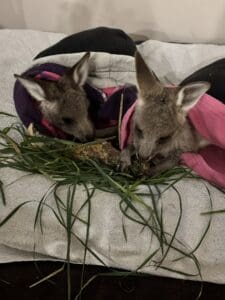
The suffering caused by unreported strikes is not abstract. Wildlife Victoria has documented cases of joeys remaining in their deceased mother’s pouch for more than a day before being discovered, developing respiratory illness, gastrointestinal damage, and renal failure from prolonged dehydration and exposure. For animals that do not die on impact, the absence of timely reporting can mean a slow, painful death that could have been prevented.
But this is not only an animal welfare issue — it is a road safety one. An injured animal left on a roadway is a hazard for every vehicle that follows. The Legislative Council Economy and Infrastructure Committee (LCEIC) found that between 2020 and 2024, Victoria Police records indicate approximately 20 people were killed in collisions where striking or avoiding a wild animal was a contributing factor, with a further 921 injury collisions recorded in that same period.
Data We Don’t Have — and Decisions We Can’t Make
Beyond the immediate harm, underreporting creates a systemic problem: we simply don’t know the true scale of the crisis. Macedon Ranges Shire Council noted that despite records of over 5,000 native animals struck in the shire, even that figure underrepresents the reality, as it excludes unreported incidents and data from other sources. Wildlife biologist Samantha Fox put it plainly: without data showing where the problem roads and hotspots are, it is very difficult to even begin considering mitigation strategies.
Mandatory reporting would close this data gap, enabling better investment in infrastructure, signage, speed zone reviews, and wildlife crossing programs where they are needed most.
What MRWN and Others Are Calling For
The solution being proposed is straightforward. The LCEIC, RSPCA Victoria, Wildlife Victoria, Defend the Wild, and MRWN are all calling for an amendment to the Road Safety Act 1986 (Vic) to require motorists to report wildlife collisions to relevant wildlife authorities. MRWN has specifically recommended that reports be made within two hours of an incident — enough time for a rescue volunteer to reach an injured animal while intervention can still make a difference.
It’s Already Working Elsewhere
Victoria would not be breaking new ground. In New South Wales, failing to report a wildlife roadstrike is already a criminal offence. In the ACT, motorists must notify a relevant authority within two hours where they cannot provide direct assistance. In Germany, it is an offence not to immediately report a collision with furred game such as deer or wild boar. The precedent is clear — this is a reasonable, practical, and proportionate legal requirement.
A Simple Ask with Real Impact
Mandating wildlife roadstrike reporting is not about punishing drivers. Most people who hit an animal in the dark on a country road are shaken and uncertain about what to do — and that’s precisely the point. A clear legal requirement, backed by simple guidance on who to call and how, would cut through that uncertainty and ensure that injured animals get help, that data is collected, and that roads become safer for everyone.
MRWN’s submission to the Victorian Parliamentary Inquiry made the case clearly and compellingly. Now it’s time for the Victorian Government to act.
If you hit a wild animal, please call Wildlife Victoria on 13 000 94535.